

What is ISSN? The International Standard Serial Number (ISSN) is an eight-digit code that uniquely identifies serial publications like journals, magazines, and newspapers, in both print and electronic formats. Understanding what ISSN is helps streamline cataloging, indexing, and retrieving serial publications in academic and library systems. It ensures the distinction between different serials, especially for cataloguing in libraries and databases. ISSNs are vital in scholarly communication, allowing seamless identification of periodicals across platforms. The ISSN system, managed by an international network, operates independently of content type, focusing on the medium of the publication.
Opprinnelsen til ISSN
What is ISSN, and why was it developed? With the growing volume of scientific literature, the need for a global system to identify serial publications led to the creation of the ISSN standard in 1971. With an increased rate of publications of scientific literature, it was required to define the system to identify the publications globally. This need led the international thinkers to define a coding system to identify print publications in their times. In the year 1971, an ISO standard ISO 3297 was drafted under the supervision of the ISSN International Centre, headquartered in Paris, France. This standard defines the ISSN number and the network of 94 countries around the world are responsible for implementing the ISSN. The whole network is coordinated by the International Centre (For more information and list of countries read her).
Den Internasjonalt standardserienummer (ISSN) ISSN spiller en avgjørende rolle i håndteringen og katalogiseringen av seriepublikasjoner. ISSN er en standardisert metode for å identifisere tidsskrifter på tvers av ulike plattformer, fra akademiske tidsskrifter til populære magasiner og til og med aviser. Dette identifikasjonssystemet sikrer at alle seriepublikasjoner, uavhengig av medium (trykt eller digitalt), kan identifiseres og katalogiseres på en unik måte, slik at man unngår forvirring og redundans.
ISSN-portalen, som utgis av ISSN Internasjonalt sentergir deg mulighet til å søk i den verdensomspennende databasen med ISSN-bibliografiske poster, som identifiserer og beskriver mer enn 2,3 millioner aviser, magasiner, tidsskrifter, monografiske serier og fortløpende ressurser av alle slag, både trykte og elektroniske, i 234 land.
Definisjon og formål
One of the major advantages of ISSN is its role in scholarly communication. To understand what ISSN is, it’s essential to recognize its role in academic publishing, where it ensures that journals and serials can be uniquely identified and efficiently cataloged. By addressing the question of ‘What is ISSN?’, researchers and publishers can better appreciate its critical function in scholarly communication and resource management. With thousands of journals being published globally, the ISSN ensures that each title has a unique identifier, regardless of language, location, or publisher. This is particularly crucial in a globalized academic ecosystem where researchers often consult international publications for literature review, data, and citation purposes.
ISSN spiller også en avgjørende rolle i biblioteksystemene. De fleste bibliotek, særlig universitetsbibliotek og offentlige depoter, forvalter store databaser med tidsskrifter. Uten et standardisert identifikasjonssystem ville det vært en nesten umulig oppgave å administrere slike databaser. Ved å tilordne et ISSN til hver enkelt publikasjon kan bibliotekene enkelt katalogisere og kryssreferere publikasjoner, og dermed sikre at de er lett tilgjengelige for brukerne.
When asking ‘What is ISSN?’, it’s important to note its distinction from the ISBN (International Standard Book Number), as the ISSN is specifically for serials while ISBN is for books. While both serve as identifiers, ISBN is used for books, and ISSN is specific to serials. ISSN is also compatible with digital tools and systems, especially when linked with the Digital Object Identifier (DOI), which is commonly used for online articles and e-journals. Together, these systems streamline the discovery and retrieval of content in both digital and physical formats.
Komponenter i ISSN
Hva er ISSN? ISSN er en 8-sifret identifikator for seriepublikasjoner, delt inn i to grupper på fire sifre (f.eks. ISSN 1234-5678). De første sju sifrene tildeles tilfeldig, mens det åttende sifferet er et kontrollsiffer som brukes til å verifisere nøyaktigheten til hele ISSN-nummeret. Kontrollsifferet beregnes ved hjelp av en matematisk formel som sikrer at ISSN-nummeret er korrekt når det legges inn eller overføres. Hvert år tildeles tusenvis av nye ISSN-er, og globalt legges det årlig til ca. 58 669 nye serietitler i ISSN-databasen.
Betydningen av ISSN
Identifikasjon
- Hvordan ISSN bidrar til unik identifisering av seriepublikasjoner.
- Forskjeller mellom ISSN og andre identifikatorer (f.eks. ISBN).
Katalogisering og bruk av biblioteket
Med fremveksten av digitale publikasjoner har ISSN blitt tilpasset for å betjene elektroniske medier like effektivt som trykte. Digitale ISSN-er (noen ganger kalt eISSN-er) tildeles til elektroniske versjoner av tidsskrifter, noe som sikrer at den digitale publikasjonen er like lett å identifisere som den trykte motparten. Dette er avgjørende i en tid med åpen publisering, der det samme tidsskriftet kan finnes i flere formater på ulike plattformer.
Additionally, publishers benefit significantly from ISSN registration. Understanding what ISSN is highlights its value for publishers, as it enhances discoverability in indexing services like Scopus and Web of Science, boosting a journal’s visibility. Many indexing services and databases require an ISSN to include a journal in their database, making it a prerequisite for scholarly recognition.
Hvordan søke om ISSN?
Registreringsprosessen
Lurer du på hva ISSN er og hvordan du søker om det? Forleggere kan starte registreringsprosessen på den offisielle ISSN-portalenog sørger for at serienumrene deres blir unikt identifisert globalt. På siden kan du fylle ut de nødvendige skjemaene.
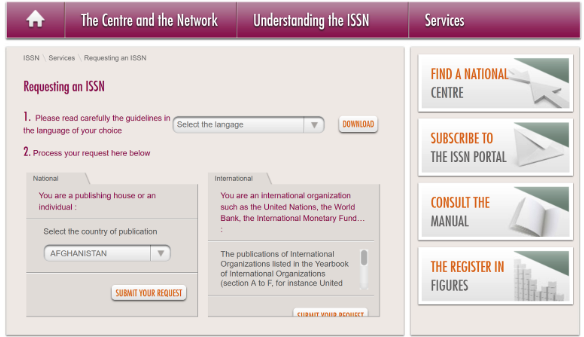
Etter å ha valgt gjennom ulike filtre og fylt ut informasjonen i tråd med retningslinjene, må utgiveren vente på godkjenning fra ISSN-myndighetene.
The publisher will be able to access the information and fill in the missing details once they are provided with the publisher’s personal access to the ISSN number dashboard. The print and online publications go through a similar screening process by national and international ISSN centres as per need. The usual processing time for the approval of ISSN ranges between 5 to 20 days as per the guideline with submission of minimal ISSN request fees.
Hvilke publikasjoner kan få ISSN?
Any print or digital publication like magazines, periodicals, websites, databases, monographs etc are eligible for obtaining an ISSN number. Information related to eligibility also can be obtained from ISSN website or from any nearby national ISSN centre.
Sammenligning med andre identifikatorer
Edit ISBN / ISSN codes are the same concept. They assign an ISBN to each of the book names. An ISBN may be assigned to particular serials as part of ISSN codes. The ISSN, unlike the ISBN code, can only be identified with an anonymous identification number and does not include details of the publisher or their place of residence. Usually the serial’s ISSN gets updated every time the name changes.
ISSN (International Standard Serial Number) er en åttesifret kode som brukes til å identifisere seriepublikasjoner som tidsskrifter, magasiner og aviser, både i trykt og elektronisk format. Det sikrer at man kan skille mellom ulike seriepublikasjoner, særlig ved katalogisering i biblioteker og databaser. ISSN er avgjørende for vitenskapelig kommunikasjon, og gjør det mulig å identifisere tidsskrifter sømløst på tvers av plattformer. ISSN-systemet, som administreres av et internasjonalt nettverk, fungerer uavhengig av innholdstype og fokuserer på publikasjonsmediet.
ISSN vs. ISBN
ISSN (International Standard Serial Number) and ISBN (International Standard Book Number) are both global identifiers for publications, but they serve different purposes. The ISSN is used to identify serial publications like journals, magazines, and newspapers, which are issued periodically. Each format of a serial (print or electronic) gets a separate ISSN. In contrast, ISBN is assigned to individual books or monographs, which are typically one-time publications. The ISSN focuses on serials’ ongoing nature, while the ISBN is specific to standalone publications or editions of books.
Konklusjon
The ISSN system is an indispensable tool in the management and dissemination of serial publications. It ensures clarity, accuracy, and efficiency in identifying periodicals across a multitude of platforms, aiding not just academic scholars but also librarians, publishers, and digital media managers. As the publishing world continues to evolve, particularly with the rise of electronic media, the ISSN will remain vital for organizing and retrieving information across the globe. Whether you’re a researcher, publisher, or library administrator, understanding the importance of the ISSN will help you navigate the complex world of serial publications.
Forbedre dine akademiske publikasjoner med Mind the Graph
As you navigate the complexities of academic publishing and ISSN registration, ensuring your research is accessible and impactful is crucial. Mind the Graph (MTG) offers researchers powerful tools to elevate their academic work with visually stunning and scientifically accurate illustrations. Whether you’re publishing a journal article with an ISSN or sharing findings in a conference, MTG enables you to communicate complex ideas effectively, enhancing the reach and understanding of your research. With MTG by your side, you can pair clarity in your serial publications with captivating visuals that leave a lasting impression on your audience.

Abonner på nyhetsbrevet vårt
Eksklusivt innhold av høy kvalitet om effektiv visuell
kommunikasjon innen vitenskap.
 Norwegian
  English
  Chinese
  Czech
Czech  Dutch
Dutch  French
  German
  Italian
  Indonesian
  Japanese
  Korean
  Polish
  Portuguese
  Russian
  Spanish
  Turkish
  Ukrainian
  Swedish
  Romanian
  Bulgarian
  Finnish
  Greek
Greek  Hungarian
  Danish
  Estonian
  Slovenian
  Lithuanian
  Latvian
  Slovak