


Over the past few years, AI tools for researchers have become crucial, simplifying everything from literature discovery to manuscript writing and manuscript editing. The challenge lies in choosing the best AI tools for research that align with specific scholarly needs. Some focus on improving clarity and grammar, others on fact-checking and citation accuracy, while a few are designed to assist with overall manuscript writing and preparation. Selecting the right tool can make the difference between a paper that struggles through revisions and one that is submission ready.
In this blog, we’ll review the top 7 AI tools for research — Paperpal, Grammarly, R Discovery, Scholarcy, Scite, Claude, and ChatGPT, highlighting how they can support writing, editing, and manuscript preparation.
1. Paperpal
If you’re looking for an AI tool built exclusively for academics, Paperpal is hard to beat. Unlike generic AI research tools, it’s designed around the needs of researchers, helping you draft, rewrite, cite, and polish manuscripts with ease. Whether you’re working on a thesis, journal article, or grant proposal, Paperpal acts like an always-available mentor guiding you toward a submission-ready draft.
Плюсы:
- Covers the full academic workflow: drafting, rewriting, editing, and journal checks
- Specialized language checks designed for research writing, not just everyday grammar
- Built-in plagiarism checker with similarity reports
- Access to 250M+ research articles and 10,000+ citation styles
- Integrates with Word, Google Docs, and Overleaf
- Strong security—manuscripts are never used to train AI models
Конс:
- Free plan limits daily AI usage
- Mostly useful for academic and technical writing, not creative content
For students, PhD scholars, or journal authors, Paperpal acts as a reliable academic assistant helping you write clearly, check compliance, and submit polished manuscripts with confidence.
And if you want to pair polished writing with compelling visuals, Mind the Graph helps create professional infographics, figures, and graphical abstracts to make your research stand out.
2. Grammarly
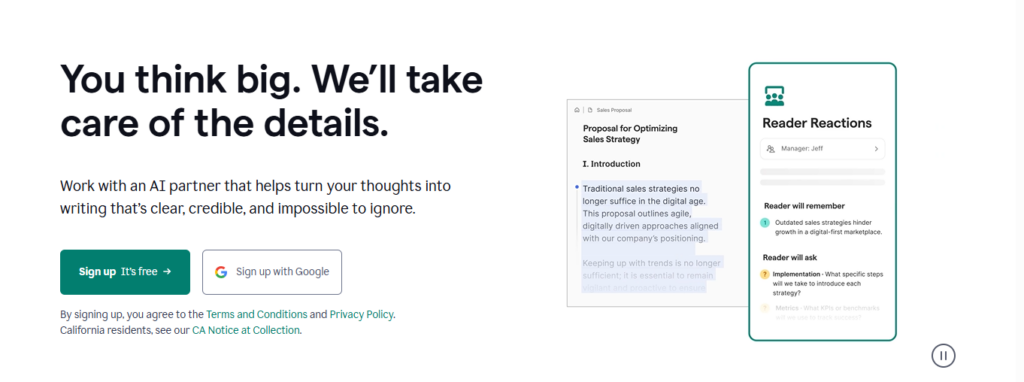
Grammarly is an AI writing assistant that has been helping students and professionals produce clear, polished writing for over a decade. It combines grammar checking, proofreading, and style enhancements with generative AI features through Grammarly Go, which can create outlines, rewrite sentences, and even generate thesis statements. For academics, its plagiarism checker scans text against 16B+ web pages and academic databases, providing originality scores.
Плюсы:
- Easy-to-use interface with real-time suggestions across platforms
- Strong grammar, spelling, tone, and clarity checks
- Generative AI support for brainstorming, rewriting, and thesis statements
- Plagiarism detection and basic citation generator (APA, MLA, Chicago)
- Works seamlessly across browsers, email, Google Docs, and desktop apps
- Free plan makes it accessible for everyday users
Конс:
- Less precise for academic jargon and discipline-specific writing
- No multilingual support (English only)
- Inconsistent with technical checks in equations, tables, and figures
- More general-purpose compared to academic-focused tools like Paperpal
Grammarly is one of the best AI tools for research when you need a solution for everyday writing, grammar checks, and readability. However, for researchers seeking deeper academic precision, it pairs best with specialized tools.
3. R Discovery
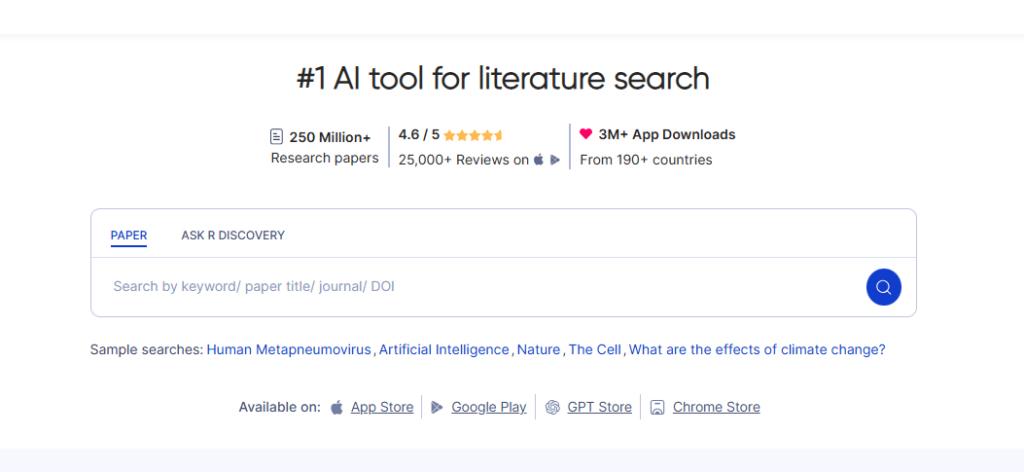
R Discovery is an AI-powered literature discovery tool that helps researchers quickly find and understand relevant academic papers. With access to 250M+ research papers, it cuts down hours of searching by offering personalized feeds, summaries, and topic alerts. Its AI Research Assistant also helps answer questions directly from papers, making literature reviews faster and more efficient.
Плюсы:
- Personalized research feeds based on your interests and reading patterns
- Access to 250M+ papers, including open-access and publisher-hosted content
- AI-powered article summaries to speed up literature understanding
- Topic alerts to stay updated with the latest studies in your field
- Research Assistant feature answers queries directly from full papers
- Integrated reading library with highlights, notes, and saved papers
- Works on web and mobile, making it easy to read anytime
Конс:
- Does not support manuscript drafting, rewriting, or editing
- AI summaries may sometimes miss niche technical nuances
- Premium features like deeper summaries and offline reading require subscription
R Discovery is ideal for students, PhD researchers, and academics who need to stay updated with recent literature, discover new papers, and manage their reading list efficiently. It doesn’t write for you, but it ensures you always have the most relevant research at your fingertips—making literature reviews significantly faster and more organized.
4. Scholarcy
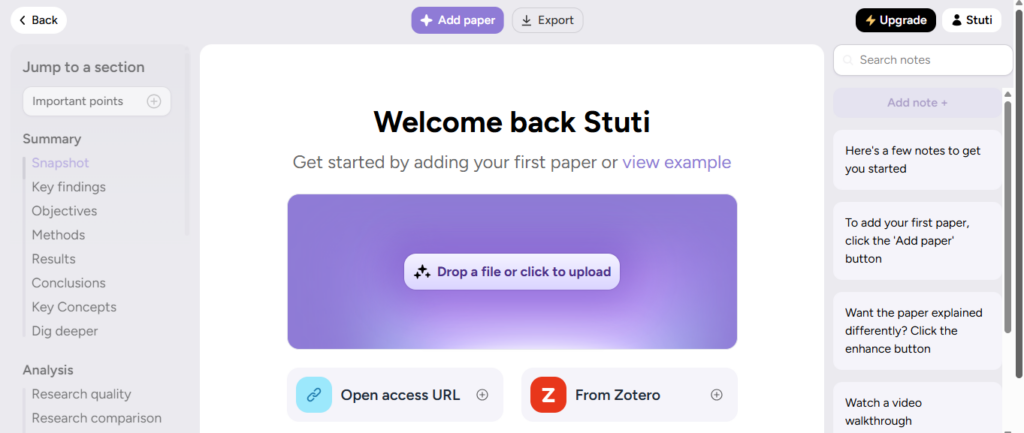
Scholarcy is an AI-powered summarization tool that helps researchers quickly understand dense academic papers, articles, reports, and book chapters. Instead of reading page after page, Scholarcy breaks documents into clear, digestible flashcards that highlight key points, references, and even figures or tables. It’s not designed to write for you but to save time by making complex research easier to navigate.
Плюсы:
- Generates concise summaries and flashcards from PDFs and Word files
- Automatically extracts references and formats bibliographies
- Can pull figures, tables, and images for quicker understanding
- Chrome and Edge extensions connect directly to open-access repositories
- Great for literature reviews and staying updated with the latest research
Конс:
- Not a writing or editing tool, only helps with summarization
- Free plan is limited to a few summaries per day
- Struggles with very complex or technical papers
Scholarcy won’t draft your manuscript, but it’s an excellent AI tool for researchers who want to speed up reading, simplify literature reviews, and keep track of references.
5. Scite
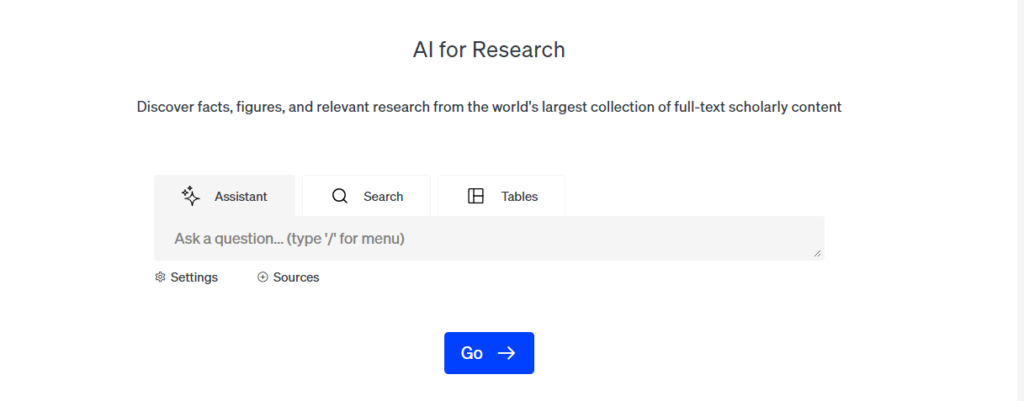
Scite.ai is a research evaluation tool that helps you go beyond counting citations. Instead of just showing how often a paper is cited, Scite tells you why by showing whether other researchers support, question, or simply mention the paper’s findings. This makes it an invaluable aid for critical literature reviews, identifying influential studies, and avoiding unreliable references.
Плюсы:
- Shows the context of each citation (supporting, contradicting, or mentioning)
- Access to 200M+ scholarly sources, including preprints and open-access works
- Summarizes research and answers questions based on the literature
- Helps visualize how studies are connected and build on each other
- Instantly see how articles are cited while reading online
- Integrates with Zotero and Mendeley for seamless reference management
Конс:
- Free plan is restrictive with limited searches
- Interface can feel overwhelming at first for new users
- Premium subscription may be costly for students on a budget
Scite.ai acts like a quality filter for research, giving you the context behind citations so you can decide which papers to trust and which to question. For anyone conducting a systematic review or building a strong reference list, it’s one of the best AI tools for researchers today.
6. ChatGPT

ChatGPT is one of the most powerful and widely used AI research tools today. While it isn’t built specifically for manuscript writing or editing, it excels at brainstorming ideas, creating outlines, simplifying complex topics, and providing instant explanations. For researchers, it can act as a 24/7 assistant helping with definitions, structuring content, or clarifying concepts.
Плюсы:
- Supports idea generation, brainstorming, and outlining
- Explains complex theories and concepts in simple terms
- Multi-language support for global researchers
- Offers advanced features like Projects, DALL·E image generation, custom GPTs, and voice mode
- Flexible for both academic and non-academic tasks
Конс:
- Not designed for academic precision, fact-checking is always required
- Doesn’t generate citations or reference lists directly
- Outputs can sometimes be overly verbose or lack natural flow
- Risk of outdated information since knowledge may not always be up to date
ChatGPT isn’t the best choice for drafting research papers, but it’s an excellent brainstorming and learning partner. Use it to clarify concepts, generate outlines, or get quick perspectives but always verify the information with trusted academic sources.
7. Claude
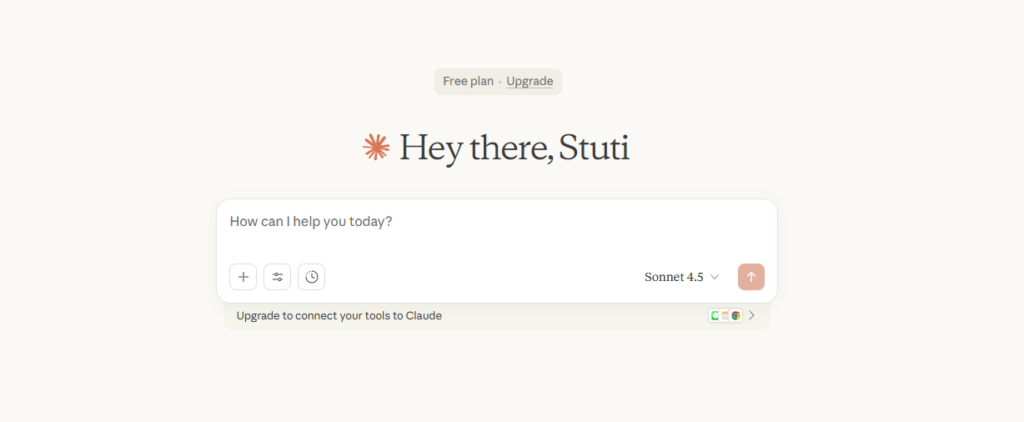
Claude is one of the newer but fast-rising AI assistants. While it isn’t as feature-heavy, it excels at handling long, complex documents and producing natural, human-like prose. With its 200K token context window, Claude can process entire books, research papers, or lengthy reports, making it particularly valuable for academics working with large datasets or manuscripts.
Плюсы:
- Exceptional prose quality—more natural and readable than many GPT models
- Handles very large documents (up to 150,000 words) with ease
- Minimalist, distraction-free interface that’s easy to use
- Useful for analyzing lengthy texts, generating summaries, or rewriting drafts
- Integrates with tools like Google Drive and supports Claude Projects for organization
Конс:
- Fewer advanced features compared to ChatGPT or Gemini (e.g., no image generation, limited voice integration)
- Heavily censored content filters may restrict some types of queries
- Still developing its ecosystem, so fewer third-party integrations
Claude may not replace specialized AI tools for research writing but it shines when you need to analyze long documents, summarize large texts, or rewrite content with clarity. For researchers dealing with massive academic papers or thesis drafts, its extended context window is a game-changer.
While the 7 AI tools for research excel in literature search, academic writing, and editing, toools like Perplexity, Wordtune and Yomu AI are also quite popular AI tools for research among students and researchers.
- Wordtune – Ideal for quick sentence rewrites and improving readability. It’s great for rephrasing sections or enhancing fluency, though it’s less tailored for academic tone compared to Paperpal.
- Yomu AI – An academic writing assistant with distraction-free UI and content structuring features. Perfect for students who prefer minimalistic interfaces with smart feedback on coherence.
- Perplexity AI – Excellent for real-time academic research. It combines conversational AI with live web search, offering citations for every response. A solid companion for fact-checking and finding the latest studies or policy papers.
Each of these tools complements the seven reviewed above, especially when used for brainstorming ideas, refining phrasing, or validating information quickly.
Enhance Your Research Drafts with Mind the Graph’s Scientific Illustrations
While AI research tools streamline writing, reviewing, and referencing, impactful research communication extends beyond text. Visuals play an equally powerful role in how your findings are understood and remembered and that’s where Mind the Graph excels.
Whether you’re creating a graphical abstract, conference poster, scientific figure, or slide deck, Mind the Graph empowers you to design visually consistent, professional-quality graphics — no design background needed.
With over 75,000 scientifically accurate illustrations, discipline-specific templates, and drag-and-drop editing, Mind the Graph helps researchers transform complex data into visuals that reviewers and readers instantly grasp. You can create everything from schematic diagrams and research workflows to molecular structures and infographics — all while maintaining journal-ready formatting standards.
How to Choose the Right AI Tool for Your Research Needs
With so many AI tools for researchers available today, the smartest approach is to start with clarity: what do you want the tool to do for you? If your main goal is manuscript writing or manuscript editing, an academic-first platform like Paperpal is ideal. If you need quick fact-checks, literature searches, or citation insights, options like R Discovery, Scholarcy or Scite might serve you better.
1. Define your goal: Are you drafting, editing, summarizing, or fact-checking? Match the tool to the task—Paperpal for manuscript writing and editing, Scholarcy for summaries, Scite for citation analysis, etc.
2. Start with a base tool: Many researchers begin with general purpose AI tools for researchers such as ChatGPT or Claude. These are flexible but less precise for academic work, so pair them with specialized tools like Paperpal for journal-ready writing.
3. Check features and security: Ensure tools that protect your data and integrate with your preferred workflow (MS Word, Google Docs, Overleaf). For academics, the security and confidentiality of manuscripts are non-negotiable.
4. Consider budget and value: Free plans are great for testing, but advanced AI research tools require richer features that are often available in paid tiers. Investing in Prime or Premium plans often pays off in higher-quality manuscripts and saved time.
5. Evaluate the learning curve: Some tools (like Overleaf) require more technical knowledge, while others (like Paperpal or Grammarly) are intuitive. Select one that fits your comfort and expertise.
6. Test before you commit: Almost all top AI tools for research provide a free trial or free plan that allow you to explore. Test them side by side to see which handles your writing style the best, whether their suggestions and corrections are contextually accurate, and how smoothly the interface fits your workflow.
In short: Don’t just pick the most popular AI research tool, select the one that aligns with your research stage, writing goals, technical requirements, and integrity needs. For most academics, combining a general AI tool with a specialized academic tool like Paperpal offers the best AI for research, providing productivity, precision, and trust.
Best Practices for Using AI Research Tools
- Acknowledge usage: Clearly state in your manuscript if you used an AI tool for research, including its name and version.
- Follow guidelines: Always check and comply with your journal’s or institution’s policies on AI use.
- Avoid plagiarism: Treat AI outputs as drafts. Verify, edit, and ensure originality before submission.
- Prioritize integrity: Don’t use AI research tools to replace your own analysis, reasoning, or academic voice.
- Combine AI with human review: Use AI as an assistant, but always proofread, fact-check, and finalize manually.
- Ensure data security: Only use tools that protect your manuscripts and research data.
Paperpal is built on these principles, offering academic-focused manuscript writing and academic editing features while keeping your work secure and original.
The Future of Research with AI
AI is reshaping how researchers write, edit, and prepare manuscripts. The best AI tools for research save time, elevate writing quality, and enhance productivity across every stage of the research process. Yet their value lies in how responsibly they are used—with transparency, human oversight, and a strong commitment to academic integrity. The takeaway is simple: Explore, test, and integrate AI thoughtfully into your workflow. When used wisely, AI research tools can become trusted partners, helping you focus on what matters most: advancing knowledge, achieving excellence, and driving scientific innovation.
Among the many AI tools for researchers, Paperpal stands out as an academic-first platform for manuscript writing and editing. It also offers reliable support with literature discovery, citation formatting, and submission readiness checks, which makes it a trusted all-in-one AI research assistant. R Discovery is perfect for staying updated with tailored reading recommendations and advanced features that boost productivity, while Mind the Graph empowers researchers to communicate their research findings visually. Together, these tools provide end-to-end support for researchers on the path to success; the best part is that they are available in one best-in-class AI research bundle when you buy the Mind the Graph Prime plan.
Mind the Graph is an easy-to-use visualization platform for researchers and scientists that enables fast creation of precise publication-ready graphical abstracts, infographics, posters, and slides. With 75,000+ scientifically accurate illustrations made by experts and hundreds of templates across 80+ major research fields, you can produce polished visuals in minutes — no design skills required.

Подпишитесь на нашу рассылку
Эксклюзивный высококачественный контент об эффективных визуальных
коммуникация в науке.
 Russian
  English
  Chinese
  Czech
Czech  Dutch
Dutch  French
  German
  Italian
  Indonesian
  Japanese
  Korean
  Polish
  Portuguese
  Spanish
  Turkish
  Ukrainian
  Swedish
  Romanian
  Bulgarian
  Finnish
  Greek
Greek  Hungarian
  Norwegian
  Danish
  Estonian
  Slovenian
  Lithuanian
  Latvian
  Slovak